Wildebeest migration safaris in Masai Mara and Serengeti National Parks, Attractions, Activities, Accommodation Lodges; Call/ Whatsapp +254723684974 for detailed information on getting there, holidays, tours, vacations and safaris, availability and where to stay, best offers, deals, discounted rates, lowest prices in luxury lodges, what to see and things to do, balloon safaris, game drives, bird watching, nature and bird walks, sun downers, champaigne breakfasts, Maasai culture and encouters, gorilla, chimpanzee hiking, trekking and safaris combinations to nearby Ngorongoro, Lake Manyara, Tarangire, Amboseli, Selous, Mikumi, Volcanoes, Gombe springs, Mahale, Nyungwe, Volcanoes, Bwindi, Lake Nakuru and Victoria in Kenya, Uganda, Rwanda and Tanzania.
For immediate booking of your Masai Mara and Serengeti Wildebeest Migration Safaris; Contact us now
Quick CONTACT: WHATSAPP: +254723684974;rnxploresafaris@gmail.com, info@gorillasafarisrwanda.com ;Telephone/ call us: +254723684974/+254702043040
The Annual Wildebeest migration also called the Great Wildebeest migration takes place in an extremely rich, contiguous and self sustaining Masai Mara Serengeti Ecosystem. The self sustainability has earned it label of the only "true ecosystem" on earth. The annual wildebeest migration also called the great Maasai (Masai) Mara /Serengeti wildebeest migration is not about wildebeests migrating per se but rather its influence on life on the whole ecosystem. Gorilla Safaris Rwanda Experts of Masai Mara Gorilla Safari/ Serengeti Gorilla Safari Combinations.
What are wildebeest Migration Safaris?
Wildebeest Migration safaris are leisure, photographic or educational trips organized in Masai Mara and Serengeti for purposes of enjoyment of, learning and photographing of wildebeest migration. They offer good learning opportunities for guides and students of animal behaviour (ethology) and individual, species and intraspecific interractions in natural ecosystem. They are equally good for nature photographers. The the spectacular crossing crocodile infested rivers, interraction with the predators and other ungualates draws a lot of interest. The wildebeest migration safaris are not confined to Masai Mara and Serengeti but all those areas frequented by migrating herds like lake Eyasi, Ngorongoro and Lake Manyara

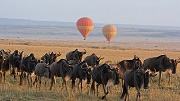
Its migration time and nothing will stand on their way not even flooded crocodile invested rivers
The Annual Wildebeest migration also called the Great Wildebeest migration takes place in an extremely rich, contiguous and self sustaining Masai Mara Serengeti Ecosystem. The self sustainability has earned it label of the only "true ecosystem" on earth. The Masai (Maasai) Mara magic is attributed to its panorama. From the vantage of rounded hills, the large expanses grassy plains teaming with herds of animals resemble a canvas painting. The overwhelming population and the rich species presentation is mesmerizing.
The wildebeest often referred to as the gnu is an antelope found in Africa south of the equator. The name wildebeest is Afrikaans / Dutch for wild beast or wild cattle. Gnu is the Khoi Khoi for the same animals. They are even-toed ungulates, belong to the family Bovidae. The name Chonnochaetes is descriptive, derived from the Greek Konnos for beards. Simply put, Wildebeest refer to the wild cattle with a beard found in the plains of East and Southern Africa. Two species- the blue wildebeest and the white tailed gnus have been identified. The white tailed gnus are found in southern Africa while the blue wildebeest are found in East Africa. Both the male and the female wildebeest have curved horns. In the Serengeti and Masai Mara ecosystems the wildebeest outnumber all the other ungulates combined.
The term "clown of the plains" in reference to wildebeest can be attributed to its funny behavior shaped by inherent characteristics of the animal. It is a dustbin of body parts of the remnants of creation. A closer look reveals at the forequarters gives the impression of one looking at an ox-horse. The head with curved horns tell us its an ox with a main of the horse, while the menacing look gives it some characteristics of a buffalo. The neck and the shoulders have tiger like stripes while the tail belongs to the horse. To complete the picture is the gait and the characteristic confusion gives an impression of animal that is likely to topple over any time.
Female wildebeest synchronize their estrous thus giving birth at the same time. Mating takes place between May and June in Masai Mara while calving takes place between February and March in Southern or central Serengeti. The mating season is characterized by a period of heightened sexual period of the males called the rut. At this time males establish temporary territory and mates with estrus females venturing into them. 90% of calving takes place in first two weeks of February. Simultaneous calving increases the chances of survival of the foals. Young ones born out of calving period are not likely to survive.
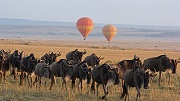
The annual wildebeest migration is not about wildebeests migrating per se but rather its influence on the movement patterns of the other animals including human beings. The migration comprise of the never ending milling of over 2.5 million wild animals composed of a about 1.7 million wildebeests, and 800,000 common Zebras and gazelle, followed closely by their predators-lions, hyenas, leopards, jackals. Hovering in the skies are thousands of vultures, the super predators. Patient in nature, they survey the migrating herds descending on the dead carcasses reducing them to skeletons in a matter of seconds. The hazardous crossing of crocodile invested Mara and Grumeti rivers is magical wonder of nature attracting thousands of human beings. This survival of the fittest spectacle has been described at the "seventh wonder of the modern world". Strategic sighting of the migrating herds tend to influence the setting up of tourism facilities.
The wildebeest migration is influenced by various factors. Wildebeest have a very selective diet. They are attracted by lush green grass hence they have keep on the move following the rain patterns. In addition wildebeest are known to congregate in plains with grasses rich in nitrogen and phosphorous. Luck or availability of these two minerals will influence where they will go. The herd mentality is an anti predation behaviour. Safety in numbers come into play. This phenomenon of acting in herds or swarms has been described as "swarm intelligence", ganging up to overcome an obstacle as one. This comes into play especially when crossing turbulent rivers. In a group, they will probably succeed in slowing down the turbulent and hence cross. In a group, they can discourage a predator from attacking. Also running in large groups makes it very difficult for a predator to focus on a specific prey. Tradition has been advanced as another factor influencing migration. That it's normal or the nature of the wildebeest is to migrate.
The wildebeest migration is mostly influenced by rainfall patterns. Thus no one can predict with precision where the migrating herds will be at a definite time. However just as in whether, a prolonged study migrating cycles has produced some good guess as regards general movements of migrating herds and some definite facts.
The wildebeest migration follows a clockwise direction dictated by the rain patterns in the Mara/Serengeti ecosystem. The Migration has been going on for as long as our ancestors can remember and where it started is debatable. If we take the calving period as the beginning of migration then we can say that migration starts in plains of Eastern Serengeti around March.
The herds spread out over wide area covering Plains of Eastern Serengeti stretching all the way to the Northern and Western plains of Ngorongoro conservation area; and Masawa Game Sanctuary. January marks the beginning of calving season. Calving continues from January to March with bulk of the calves born in mid February. During this period the plains of Seronera all the way to Western Ngorongoro are teaming with vast herds of wildebeest (about 1.7M) with their calves. It is the feasting time of predators as they take advantage of the weak and venerable foals. The wildebeest are always on the move and not even calving will disturb this rhythm. Upon delivery, within minutes, they young calf can stand and walk with the herd. In a few days, it can outrun any predator. The best places to stay at this time are Kusini Camp and Ndutu Lodge.
May marks the end of long rains in Eastern Serengeti and Northern Ngorongoro. Meanwhile the calves have matured and it is migration time. The scattered herds gather into long columns of up to 20 miles and the march westwards begins. The migrating herds cross central Serengeti into the Ngurumet (popularly called the western corridor), cross the Ngurumet river into western and northern plains of Serengeti. By the end of June, the rains in western and northern Serengeti have subsided. At this time, heavy rain is falling in the Mau hills and the crocodile infested Mara river is heavily flooded. But nothing will stand between the wildebeest and the abundant succulent grass readily available in western Masai Mara, not the floods nor the crocodiles. The wildebeest must cross of else risk starvation. With lots of vocalization wildebeest gather in herds along the banks of the Mara river. Unmoved by the noise the crocodile patiently waits and guards their territories against the intruding wildebeest. Any wildebeest venturing into the river is met immediate hostility and retreats but cannot go far due to the ever increasing multitudes of the wildebeest. As time goes, the impatience grows and the wildebeest in front can no longer withstand the push from behind. They is no turning back. They have to take a plunge. As if to confuse the crocodiles, they jump into the river in mobs. The lucky ones wade across into the land of plenty. The unlucky ones drown, others are killed or maimed by the crocodiles . By the end of the cross, the banks of mara river are lined with carcasses of the dead. It is survival of the fittest and those maimed will not survive the predators of Masai Mara. route from Masai to Serengeti and Ngorongoro.
The arrival in Masai Mara coincides with the mating season. The bulls establish temporally territories and mate with the females crossing into them. The herds settle in Masai Mara moving from the Western side to the Eastern boundaries. By October the succulent grass in Mara is finished and the migrating herds heads for Serengeti where curving will take place and the entire cycle starts all over again.
January, February- it is usually dry with the grass cropped short. April-July long rains. Mid-July- September migration
"A major environmental concern in Maasai (Masai) Mara is the proliferation of unplanned development in the adjacent community/ group ranches. Currently there are approximately 108 properties in greater Mara with a bed capacity of 4000. A large proportion of the properties are in the community group ranches. Game lodges, tented camps, private houses and campsites are all found in Mara." Maasai Mara has the largest number of lodges and tented camps in any park of East Africa.
To book lodges in Masai Mara Email us: rnxploresafaris@gmail.com/ WhatsApp/Tel: +254723684974
These luxury tented camps in Mara offer highest degree of comfort.
To book luxury tented camps in Masai Mara Email us: rnxploresafaris@gmail.com/ WhatsApp/Tel: +254723684974
Maasai Mara offers good opportunities for camping. The following campsites have permanent tents offering basic accommodation with hot showers and meals at affordable prices. Thes include:

North Coast of Zanzibar is a special holiday destination ideal for week long stays, honey moons or weekend escapes. Zanzibar is an ideal destination for holiday getaways,relaxation and adventure. Zanzibar + Masai Mara are the places to visit if you desire to combine beach holidays with water sports and big game watching. Top of the range of the hotels are:
Car Hire Kenya


 1
1 2
2 3
3 4
4 5
5 6
6 7
7 8
8 9
9 10
10 11
11 12
12 13
13 14
14 15
15 16
16 17
17 18
18 19
19 20
20 21
21 22
22 23
23 24
24 25
25 26
26